
Our Projects
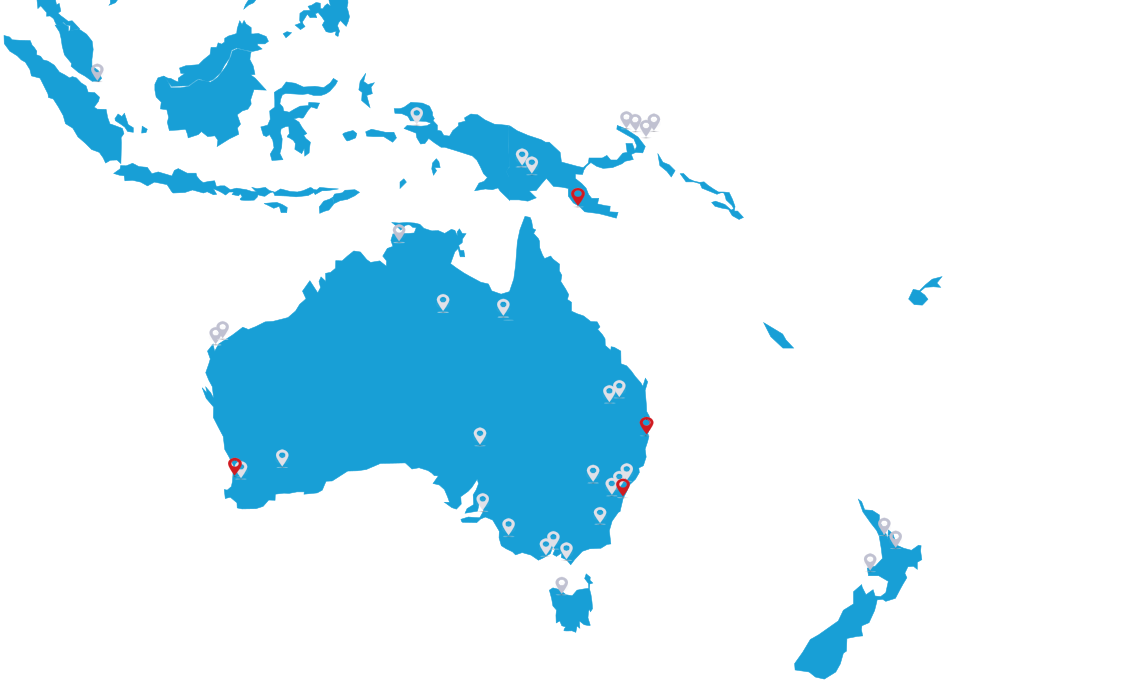
Spiecapag has been active in the Asia Pacific Region for over 40 years, delivering some of the most ambitious pipeline infrastructures in Australia as well as all the major long-distance, high-pressure gas pipelines in Papua New Guinea.
GALLERY
Pelican Point Lateral Relocation Project
Lefevre Peninsula, Osbourne, SA, Australia
2026-2028
Pelican Point Lateral Relocation Project
Lefevre Peninsula, Osbourne, SA, Australia
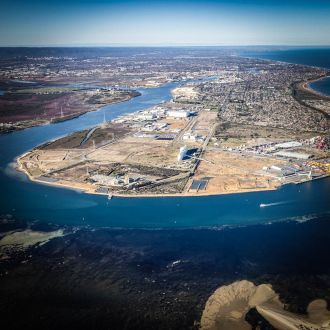
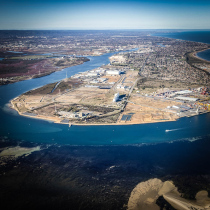
Awarded under an Engineering, Procurement and Construction (EPC) contract, the Pelican Point Lateral Pipeline Relocation Project involves the delivery of a new 3.9-kilometre DN450 gas pipeline to replace the existing Pelican Point Lateral.
Located on the Lefevre Peninsula, approximately 19 km northwest of Adelaide, the project forms part of the Moomba to Adelaide Pipeline System (MAPS), owned and operated by Epic Energy.
Initiated by Australian Naval Infrastructure (ANI), the pipeline relocation will ensure continuity of gas supply while enabling major infrastructure development at the Osborne Naval Shipyard (ONS), supporting one of
Australia’s most significant defence infrastructure programs.
Under its contract with Epic Energy, Spiecapag’s scope includes:
- Full EPC delivery of the new pipeline
- Installation of a ~3.9 km buried DN450 pipeline, including a ~660 m horizontal directional drill (HDD) beneath the Port Adelaide River
- Construction of associated facilities including offtake stations, pig launcher and receiver systems, and cathodic protection infrastructure
- Decommissioning and abandonment of the existing Pelican Point Lateral pipeline
The pipeline will be constructed using API 5L X60 steel and delivered in accordance with AS/NZS 2885 standards, alongside stringent environmental, safety, and cultural heritage requirements.
Mobilisation is anticipated in Q4 2026, with completion expected in late 2027 / early 2028. The project will draw on both local and interstate workforce, supporting local employment and capability development.

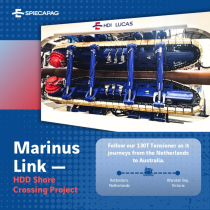
Marinus Link - HDD Shore Crossing Project
Waratah Bay (VIC) and Burnie (TAS), Australia
2024-2027
Marinus Link - HDD Shore Crossing Project
Waratah Bay (VIC) and Burnie (TAS), Australia

Type of project: Renewable Energy Infrastructure
Client: Prysmian
Selected by global cabling solutions provider Prysmian, Spiecapag will deliver the Landfall HDD scope of the Marinus Link project.
The Marinus Link project will improve the electricity and telecommunications connection between Tasmania and Victoria via 345 km of high-voltage direct current (HVDC) cables and fibre optic cables. It includes 255 km of subsea cables across the Bass Strait and 90 km of underground cables in Gippsland, Victoria.
Marinus Link will facilitate the transmission of more energy and data between Tasmania and Victoria, enabling Tasmania to import excess solar and wind energy produced in Victoria and export its hydropower later to meet peak demand interstate.
As part of the Marinus Link Project, Spiecapag will be delivering 10 shore crossings, 5 on each side of the Strait, via its HDI Lucas arm. The Victorian side of the project will be located near Waratah Bay, while the Tasmanian side will be in Heybridge, near Burnie.
“We are thrilled to partner with Prysmian and Marinus Link on this significant project,” said John Stuart-Robertson, General Manager of HDI Lucas. “Our expertise in HDD and Prysmian’s leadership in cable systems will ensure the successful delivery of the Marinus Link Project, contributing to a more sustainable and reliable energy future for Australia.”
The Marinus Link Project is jointly owned by the Australian, Tasmanian, and Victorian governments and is a critical infrastructure project aimed at enhancing energy security and supporting the transition to renewable energy sources. The first 750 MW of Marinus Link will help Australia meet its net-zero emissions reduction targets by saving up to 70 million tonnes of CO2 equivalent by 2050.
Snowy 2.0 Longitudinal Drainage Bores Project
Kiandra, NSW, Australia
2026
Snowy 2.0 Longitudinal Drainage Bores Project
Kiandra, NSW, Australia
Type of project: Renewable Energy infrastructure
Client: Future Generation Joint Venture (FGJV)
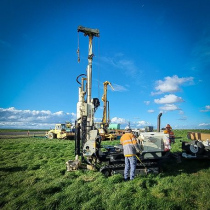
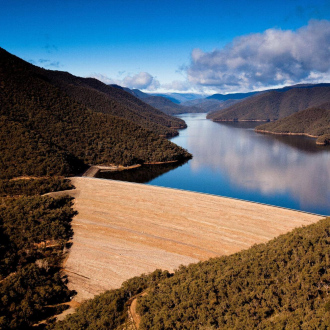
Spiecapag Australia has been contracted by Future Generation Joint Venture (FGJV) to deliver the design and drilling of 2 drainage holes, each approximately 1,800 metres in length, as part of the Snowy 2.0 project, a large‑scale pumped hydro energy storage project in New South Wales. The work will be delivered by HDI Lucas, Spiecapag’s HDD team.
“Our HDD expertise will help overcome the complex geological challenges of the Snowy Mountains region and support the delivery of Australia’s largest renewable energy project” says John Walsh, Managing Director at Spiecapag. “Spiecapag is proud to contribute to the Snowy 2.0 project, which will play a vital role in Australia’s clean energy transition.”
Overview of Snowy Hydro 2.0

Kurri Kurri Lateral and Storage Pipelines Project
Kurri Kurri, NSW, Australia
2023-2025
Kurri Kurri Lateral and Storage Pipelines Project
Kurri Kurri, NSW, Australia

Type of project: Gas Infrastructure
Client: APA Group
The Kurri Kurri Lateral & Storage Pipelines Project, delivered for APA Group, is one of our most technically ambitious and strategically significant infrastructure achievements in Australia.
Spanning over 45 km of high and medium pressure gas pipelines, this was a complex suburban project including 7 HDDs, 8 thrust bores, 9 creek crossings and multiple associated facilities – all executed to the highest standards.
A standout feature of the project was the Kurri Kurri “Bottle” Gas Storage Pipeline: 24 km of 42-inch, high-pressure buried pipeline laid in a unique recoiled loop configuration on an L-shaped platform, a first of its kind in Australia. With a significant amount of storage capacity, this innovative infrastructure acts as both a buffer and strategic reserve, ensuring reliable energy supply. This important development will deliver fast-start gas to support firming capacity in the National Electricity Market. It will play a critical role in enabling the transition to renewables by providing on-demand energy during periods of low solar and wind generation.
From managing two parallel projects and importing specialised plant from France, to navigating tight access corridors and implementing automatic welding technology, the project team demonstrated exceptional collaboration, adaptability, and engineering excellence.

JANSZ-IO Compression - HDD Shore Crossings Project
Barrow Island, WA, Australia
2022-2025
JANSZ-IO Compression - HDD Shore Crossings Project
Barrow Island, WA, Australia

Type of project: LNG Infrastructure
Client: Chevron
The JANSZ-IO Project was a life extension activity, providing compression to the JANSZ-IO gas field to maximise recovery from the reservoir and maintain plateau supply to the Gorgon LNG plant. The JANSZ-IO field is located approximately 130 km north-west of Barrow Island in Western Australia in water depths of approximately 1350 m.
Spiecapag was contracted to install, by way of Horizontal Directional Drilling, two 540m shore approaches consisting of DN630 HDPE to house umbilical cables, including two onshore trenches to facilitate umbilical pull-in and cut-over to existing infrastructure.
The project scope also includes civil works on the North-West of Barrow Island to construct the HDD pad, lay-down area, seawall, anchorage and seawater supply for drilling; onshore trenching and excavation, installation of pre-cast concrete and assisting with umbilical pull-in; as well as rehabilitation works/reinstatement.


Lihir Ground Stabilisation Project (MOSA JV)
Lihir Island, Papua New Guinea
2021-2025
Lihir Ground Stabilisation Project (MOSA JV)
Lihir Island, Papua New Guinea

Type of project: Retaining Wall – Mining Infrastructure
Client: Newmont Corporation
Delivered for Newmont Corporation, the Lihir Ground Stabilisation Project was a first-of-a-kind, and highly technical project undertaken in partnership with Spiecapag’s sister company, Menard Oceania. It consisted in securing a benched retaining wall with cabled strength anchors in a geothermally active environment to enable mining operations to continue in the area.
Three benches were stabilised over the course of 46 months, with an impressive 1,315 ground anchors and 4,425 metres of waler beam. Even more remarkable: the project had no time lost to injuries with approximately 2.3 million hours worked, a testament to the team’s unwavering commitment to safety & excellence!


Lenaghan Lateral and Metering Station Project
Kurri Kurri, NSW, Australia
2024
Lenaghan Lateral and Metering Station Project
Kurri Kurri, NSW, Australia

Type of project: Gas Infrastructure
Client: Zinfra
From April to September 2024, the Spiecapag Team was contracted by Zinfra to deliver a metering station and a 450-metre gas pipeline to supply gas from the Jemena Gas Network to Snowy Hydro Hunter Power Project. This gas-fired power station will help meet electricity demand as Australia transitions to renewable energy. Despite weather challenges, the project was delivered 18 days ahead of schedule.
Check out our time-lapse footage to see it all unfold.

Western Outer Ring Main Project
Melbourne, VIC, Australia
2024
Western Outer Ring Main Project
Melbourne, VIC, Australia

Type of project: Gas Infrastructure
Client: APA Group
The Western Outer Ring Main (WORM) project was a high-pressure, buried gas transmission pipeline delivered for APA Group, providing a new connection between pre-existing pipelines at Plumpton in Melbourne’s west and Wollert in the north. The project also included an upgrade to the existing compressor station at Wollert.
As the main contractor, Spiecapag delivered the construction of the 51km DN500 high-pressure steel pipeline – with external epoxy coating, partially laid in existing easement (approximately 8 km, Wollert to Wodonga Pipeline) and the rest in greenfield easement.
Following extensive consultation with landowners, occupiers and other stakeholders, the final alignment was selected to minimise impacts. The topography of the route was generally flat; however, there were several very steep gullies at creek crossings. The project included 3 km of trenchless crossing including seven HDDs (six of them major waterway crossings) and twelve bores.
This project mobilised 300 staff, 75% originating from the project area. 80% of the equipment procured also originated from the Melbourne area.


Kewdale White Oil Line Project
Perth, WA, Australia
2020-2023
Kewdale White Oil Line Project
Perth, WA, Australia

Type of project: Oil Infrastructure
Client: NEWest Alliance
The Kewdale White Oil Line (KWOL) project entailed the relocation of a 13km pipeline from BP’s Kwinana refinery to the Kewdale Freight Terminal of Perth Airport, a requirement arising from the Thornlie Cockburn Link railway project.
Spiecapag was contracted for detailed design and construction of the new DN300 oil pipeline to be installed through Perth’s southern suburbs. A congested construction corridor (<5m wide) as well as proximity to local residences led to a concept design with over 90% of the pipeline to be installed using HDD bores.
Over 12 km of the pipeline was constructed using the HDD method across eleven crossings, eight of which exceeded 1 km. Each crossing was complex in nature, affected by adjacent railway activities, magnetic interference, limited work area and challenging geology. This was one of the largest HDD projects completed in a single pipeline in Australia.


Simberi Deep Sea Tailings Pipeline Project
Simberi Island, New Ireland, Papua New Guinea
2021-2022
Simberi Deep Sea Tailings Pipeline Project
Simberi Island, New Ireland, Papua New Guinea

Type of project: Mining Infrastructure
Client: Saint Barbara Gold
Saint Barbara Gold contracted Spiecapag for the renewal of their 500m+ DN1000 HDPE Deep Sea Tailings Pipeline and their seawater intake pipeline. The pipeline had been in service since 2007 and ran from the process facility in Pigiput Bay south-east out to the seabed. Initially our scope involved welding the new pipeline, stringing and fitting ballast to allow the mine to restart operations, however due to a new bathymetric survey, the alignment was radically redesigned.
The new alignment increased the complexity of the scope, and we provided custom designed and fabricated new restraining and support mounts. We worked with Saint Barbara to develop a new solution and were able to continue the replacement operations without significant delay.
The new pipeline and route included several turns, and many more ballast blocks required additional towing capacity. Spiecapag coordinated the increase in scope and managed the towing and final sinking utilising six vessels.

TK050 & TK2050 - Lihir Island Tailings Lines Projects
Lihir Island, New Ireland, Papua New Guinea
2020-2021; 2023
TK050 & TK2050 - Lihir Island Tailings Lines Projects
Lihir Island, New Ireland, Papua New Guinea
Type of project: Mining Infrastructure
Client: Newcrest
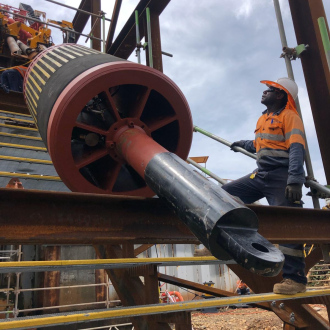
Spiecapag successfully delivered two deep-sea tailings pipeline rehabilitation projects on Lihir Island, located 643 km off the coast of mainland Papua New Guinea, at a gold mine with dense infrastructure.
TK050, in 2020-2021, involved the recovery and reinstallation of a DN1200 HDPE liner pipe used for tailings placement to a water depth exceeding 100 m. The pipeline, over 200 m in length, was connected to a submerged tank that gravity-fed tailings to the ocean at a 37-degree angle.
TK2050, in 2023, focused on the removal and replacement of an existing 250m DN1200 HDPE tailings liner pipeline. The scope included removing the old liner, installing a hauling frame, welding and hydrotesting the new pipe, and securing it into a 33-degree offshore deep-sea tailings outfall.

Channel Island Bridge Pipeline Replacement Project
Darwin, NT, Australia
2021
Channel Island Bridge Pipeline Replacement Project
Darwin, NT, Australia

Type of project: Gas Infrastructure
Client: APA Group
This Channel Island Bridge Pipeline Project required the installation of a 1.4km DN300 pipeline via HDD between Channel Island, where the Channel Island Power Station is located and the Darwin mainline.
The HDD crossing under the waterway was completed through varying geology up to 250MPa rock strength. The profile was very complex with a compound curve arrangement completed to minimum pipe bending radius during the last 400m of the crossing.
Works included modifications to existing station piping at Darwin City Gate and the Channel Island Meter Station facilities to install pig launching and receiver facilities along with gas filtration and an upgrade to monitoring instrumentation.

Mardi to Warnervale Water Pipeline Project
Mardi/Warnervale, NSW, Australia
2020-2021
Mardi to Warnervale Water Pipeline Project
Mardi/Warnervale, NSW, Australia

Type of project: Water Infrastructure
Client: Central Coast Council
The $39 million Mardi to Warnervale Project comprised the construction of an 8.9km DN1000 water pipeline from the Mardi Water Treatment Plant to Sparks Road in Warnervale; crossing road reserves, council land, private land and sensitive environmental areas demanding the use of trenchless technologies.
The Mardi to Warnervale Pipeline was made up of a multitude of intricate engineering projects split into twenty-three different sections. Key to this success was drawing from the joint venture’s strengths such as the pipeline expertise and experience of Spiecapag, trenching and HDD activities of their subsidiary HDI Lucas, along with Seymour Whyte’s experience in subcontractor management, roadwork, brownfield roadworks, traffic control covering the thrust bore, civil and structural activities.
The project was key to securing the future water needs of the Central Coast community. It will service projected expansion in the major northern growth corridor including Warnervale Town Centre and surrounding greenfield subdivision sites. It will also enhance bulk water transfers between the Central Coast and the Hunter Region, enabling better planning for future water resourcing and helping both regions better manage potential future drought conditions.
The project was delivered 1 week ahead of contracted completion schedule.
Northern Interceptor Pipeline Project
Auckland, North Island, New Zealand
2019-2020
Northern Interceptor Pipeline Project
Auckland, North Island, New Zealand

Type of project: Wastewater Infrastructure
Client: Fletcher (Watercare)
The Northern Interceptor Pipeline Project was a new wastewater pipe designed to redirect flows from the North-western areas of Auckland (New Zealand) to the Rosedale Wastewater Treatment Plant in Albany.
The final pipeline design incorporated dual DN500 HDPE PN16 sewage rising mains and a DN200 HDPE conduit for future fibre optic cable installations under the Upper Waitematā Harbour and Te Wharau Creek.
The total drilling length was more than 5,000 m, each of the triple-harbour crossings exceeding 1,100m in length through parallel curves, and each of the triple-Te Wharau Creek crossings exceeding 560m in length.
The crossings were completed in challenging rock and clay conditions, requiring detailed planning and preparation to ensure the crossings were constructible and risk was as low as possible. The bottom hole assemblies were manufactured utilising variable jet configurations to overcome the East Coast Bays Waitematā rock and sticky clay. The project also needed to complete detailed planning and negotiation to secure suitable stringing areas, as the urban location of the pipeline meant that options large enough to be safe and suitable were severely limited.


Tuas Shore Crossing - Undersea Cabling Project
Tuas Western Coast, Singapore
2019
Tuas Shore Crossing - Undersea Cabling Project
Tuas Western Coast, Singapore

Type of project: Telecommunication Infrastructure
Client: JTC Corporation
As part of a major land reclamation initiative led by JTC Corporation at Tuas Western Coast, Spiecapag was engaged to divert SingTel’s undersea cable systems to enable dredging operations.
The project involved the installation of two 700-metre shore approaches using 250 mm OD casing, positioned 45 metres deep beyond the planned dredging zone.
Scope of work included:
- Construction and maintenance of launch pits and work areas,
- Provision and transportation of all required materials, equipment, and consumables,
- Execution of all support activities necessary for the successful completion of the cable diversion.
This complex offshore operation was successfully completed, ensuring minimal disruption to existing telecommunication infrastructure while supporting Singapore’s coastal development.

Atlas Lateral Pipeline Project
Wandoan, Surat Basin, QLD, Australia
2019
Atlas Lateral Pipeline Project
Wandoan, Surat Basin, QLD, Australia
Type of project: Gas infrastructure
Client: Jemena
In the wake of the successful Northern Gas Pipeline Project, Spiecapag was invited by Jemena to participate in the early-stage development of the Atlas Project. This included providing constructability input on the design to enable the client to optimise the pipeline route and construction timeline.
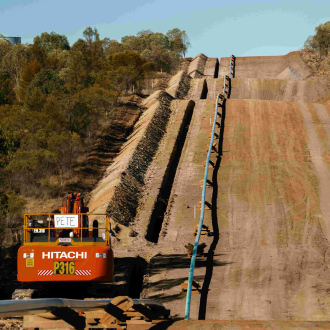
In just five months Spiecapag delivered 60 km of DN200 high-pressure steel gas pipeline, connecting the new Atlas compression station to the existing Jemena Darling Downs Pipeline. Our mainline construction crews were able to average 2.5 km/day, while maintaining the highest standards of safety and quality. Construction of the pipeline required watercourse crossings, live service crossings and road crossings using a variety of techniques such as HDD, Auger Bore and traditional open cut trenching.
As principal contractor, Spiecapag was responsible for all construction aspects of the project – including survey, clear & grade, pipe handling, trenching, welding, lowering in, testing and rehabilitation. All 60 special crossings (including 38 watercourses, 16 live gas pipelines and 4 roads) were completed safely and efficiently by our dedicated crews.

Phillip Creek Compressor Station Interconnectors Project
Warumungu, NT, Australia
2018-2019
Phillip Creek Compressor Station Interconnectors Project
Warumungu, NT, Australia

Type of project: Gas Infrastructure
Client: Jemena
Spiecapag constructed the interconnectors required to complete the final tie-in works at the Phillip Creek Compressor Station. The scope included installation of the 100m interconnect line from the compressor to the APA Amadeus Gas Pipeline (AGP) and 150m interconnect line to the newly installed Northern Gas Pipeline (NGP). The scope also included above-ground pipework and the fabrication of pipe storage racks.

Tauranga Southern Wastewater Pipeline Project (Harbour Crossing)
Tauranga, North Island, New Zealand
2018
Tauranga Southern Wastewater Pipeline Project (Harbour Crossing)
Tauranga, North Island, New Zealand

Type of project: Wastewater Infrastructure
Client: Tauranga City Council
The scope of the Tauranga Southern Pipeline included design and construction of a major wastewater pipeline between Memorial Park Pump Station, across the Tauranga Harbour to Tauranga Southern (Wastewater) Pipeline on the North Island of New Zealand.
The purpose of the pipeline was to relieve the burden on the city’s sewage treatment plant, allowing it to improve its performance. The harbour pipeline was HDD drilled at a depth of 40m under the seabed.
- Approximately 1570 meters drilled from Memorial Park to Matapihi.
- A 1500mm outer casing was driven in on both sides of the Harbour.
- A 1000mm steel casing was installed by HDD, to accommodate an inner 800mm PE pipe.
Project works included all required support activities; construction and maintenance of launch pit and work area; provision and transportation of consumables, material and equipment

Tangguh LNG Expansion Project
West Papua, Indonesia
2018
Tangguh LNG Expansion Project
West Papua, Indonesia

Type of project: Gas infrastructure
Client: BP/SAIPEN
The Tangguh Expansion Project was an expansion of the Tangguh liquefied natural gas (LNG) facility located on the southern shore of Bintuni Bay in Teluk Bintuni Regency of Papua Barat Province (West Papua).
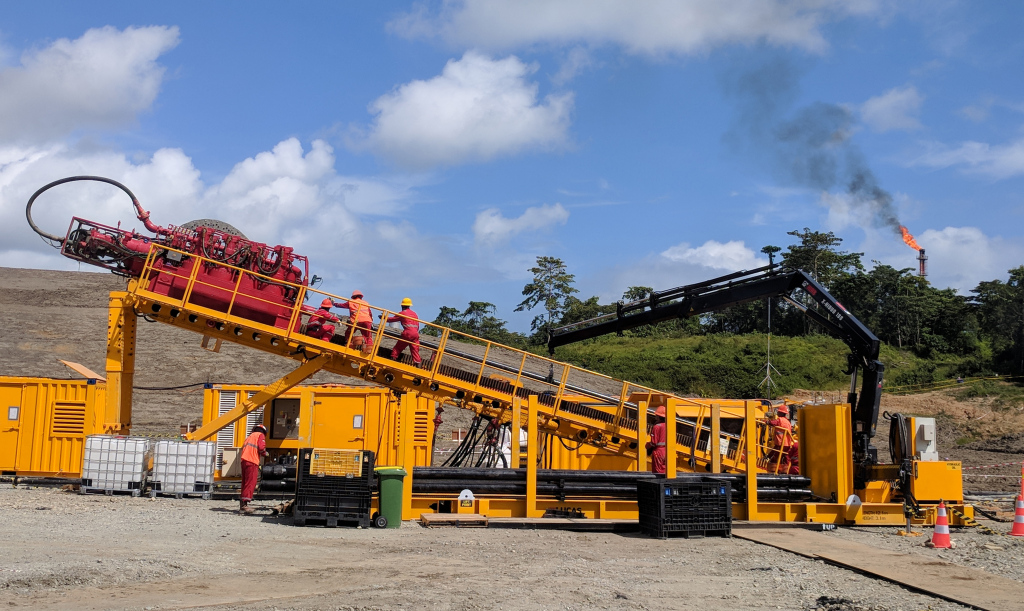
The expansion increased the production capacity of the LNG plant by approximately 50% to 11.4 Mtpa. The full project included the construction of two offshore platforms, 13 new production wells, an expanded loading facility and associated infrastructure. The Tangguh LNG Expansion HDD project required:
• Three HDD landfalls 2065 meters in length.
• Two 16-inch diameter boreholes for the installation of 10-inch casings.
• One 40-inch diameter borehole for the installation of 24-inch product pipe.
Project works included all required support activities; construction and maintenance of launch pit and work area; provision and transportation of consumables, material and equipment.

Northern Gas Pipeline Project
Tenant Creek (NT), Mount Isa (QLD), Australia
2017-2018
Northern Gas Pipeline Project
Tenant Creek (NT), Mount Isa (QLD), Australia

Type of project: Gas infrastructure
Client: Jemena
Spiecapag was contracted by Jemena to deliver the 143 km of DN300 steel gas pipeline and associated crossings, civil and mechanical works for the Queensland section of the NGP Project. The scope of work included a start of line receipt/compressor station, three Main Line Valve (MLV) facilities along the pipeline, an end of line delivery station, and five cathodic protection stations.
Due to land access restrictions at the Mount Isa (Eastern) end of the pipeline, Spiecapag was required to perform the works from west to east. This involved a full camp and laydown area to be constructed beforehand. The camp mobilisation and construction schedule was critical and Spiecapag pulled out all the stops to ensure this was performed in an expedient manner.
The project was originally planned to be built around the wet season, with 93 km scheduled to be completed before the wet season, and the remainder as part of a remobilisation in March. Due to early access and high productivity rates, Spiecapag safely completed all mainline construction activities prior to the Christmas period, avoiding the need for the second mobilisation in March.
Working in a remote part of Queensland, Spiecapag engaged extensively with local businesses, including indigenous communities, where job-specific training was delivered, leading to 24% of our workforce coming from Indigenous communities.

Victoria North Interconnect Expansion Project
Wollert (VIC), Wodonga (NSW), Australia
2015-2017
Victoria North Interconnect Expansion Project
Wollert (VIC), Wodonga (NSW), Australia

Type of project: Gas infrastructure
Client: APA Group
Spiecapag was awarded the contract for the construction of 165 km of domestic gas looping pipelines comprising 95 km of DN400 pipe in Victoria and 70 km of DN450 pipe in NSW. Crossing hundreds of rural and semi-rural properties, the project included seven loops spread over 500 km, two of which were in NSW and five in Victoria. The entire pipeline was constructed within the easement of an existing live high-pressure pipeline. Detailed engineering analysis was undertaken, and strict processes put in place to guarantee the integrity of the existing line throughout the project.
As the loops were spread over 500 km, three offices and logistics yards were established in Young (NSW), Wangaratta (VIC), and in Cootamundra (NSW).
The full scope of the works included six Main Line Valves, scraper stations, pig launcher, receivers associated pipe supports, civils works and E&I works in the facilities compounds, eleven tie-ins, four railway crossings, and thirty-eight HDD road crossings.

Eastern Goldfields Pipeline Project
Murrin Murrin, WA, Australia
2014-2015
Eastern Goldfields Pipeline Project
Murrin Murrin, WA, Australia

Type of project: Gas infrastructure
Client: APA Group
The Eastern Goldfields Pipeline Project totalled 293 km of gas pipeline across the Great Victorian Desert from Murrin Murrin to two offtakes, one at KP83 and the second at KP293 in a region 12-hour drive north-east of Perth.
Spiecapag’s scope of work included all construction elements of the gas pipeline from clear and grade to re-instatement. The works included operating multiple workfronts, each delivering 5 km of productivity per day on average to achieve project schedule.
The project was delivered early at both off-take points, enabling early commissioning and gas up of the pipeline, with no time lost due to injuries (LTIFR = 0).
Proactive environmental practices on the project resulted in the team being awarded industry environment awards for excellent fauna management.

Trunklines North Pipeline Project
Surat Basin, QLD, Australia
2014
Trunklines North Pipeline Project
Surat Basin, QLD, Australia

Type of project: Gas infrastructure
Client: Shell QGC
Spiecapag completed the construction of 51 km of gas pipelines (DN350, DN400 and DN500); 167 km of buried high-voltage cables; 23 km of water trunkline (DN600, MSCL); and 84 km of fibre optic cable as part of the upstream portion of works for the larger QCLNG project.
The project was a brownfield development, and the construction was made more complex by the high number of trenches in the same working width: one particular stretch of right of way had seven trenches running in parallel which gave rise to challenges with work area management and simultaneous operations.
The project successfully delivered one hundred and fifty-five crossings of road, water courses, or existing pipelines, with forty-five special crossings carried out under strict permit-to-work conditions. Mid-line isolation valve assemblies, above ground pressure regulating stations (including duty and standby runs, isolation valves, drain valves, pressure indicators, pressure transmitters, and solar powered RTU’s), high point vents and scour outlets were installed by dedicated crews or subcontractors directly managed by Spiecapag.
The water pipeline was completed with zero defects, and all seven hydrotest sections passed at the first test. Most importantly, the project was completed with zero incidents and a TRIFR of 0.00, thanks to the implementation of project-specific safety initiatives developed in house. The project was recognised with awards for its safety performance.

PNG LNG Project
Hides region, Southern Highlands, Papua New Guinea
2009-2014
PNG LNG Project
Hides region, Southern Highlands, Papua New Guinea

Type of project: Gas infrastructure
Client: ExxonMobil
The PNG LNG Project is one of the most significant energy infrastructure developments ever undertaken in Papua New Guinea. Designed to unlock major gas and liquid hydrocarbon resources in the Hides region of the Southern Highlands, the project required the delivery of a complex onshore pipeline system through some of the most remote and challenging terrain in the world.
Over five years, Spiecapag was involved in the engineering, procurement and construction phases (EPC contract), delivering over 450 km of onshore pipelines that transport natural gas from the Hides Gas Conditioning Plant (HGCP) to the Omati River where it connects to the offshore pipeline and the condensate product from HGCP to Kutubu CPF.
Project Scope
The scope of the work included a gas main line of 266 km of DN800, 27 km of DN860, 2 km of DN300 and 10 km of DN250 of gas pipeline, as well as 109 km of DN200 condensate pipeline. In addition to the pipelines, Spiecapag delivered associated infrastructure including custody transfer metering systems at Kutubu and Gobe, helipads, fibre optic cable installation and high-voltage power cabling.
Extreme operating environment
Construction was undertaken in a true greenfield environment, with no pre-existing road networks or supporting infrastructure across much of the route. The alignment crossed extremely rugged and varied terrain, including steep mountain slopes, swamps and wetlands, unstable soils, active fault zones and dense tropical rainforest.
The project area experiences year-round rainfall, with up to nine metres of rain annually, high humidity and temperatures regularly reaching 30–40°C. These conditions required resilient planning, flexible execution strategies and continuous mitigation measures to manage landslides, flooding and access disruptions while maintaining project momentum.
Engineering and logistics challenges
Logistics represented one of the project’s greatest challenges. Line pipe was transported from cargo ships onto barges and moved through the river network to the Kopi laydown yard, before being distributed along a 293 km pipeline route with no existing access. To enable construction, Spiecapag built roads and bridges, constructed floating bridges, and delivered more than 100 km of access tracks across volcanic soils and marshland.
Specialist construction methodologies were employed throughout the project, including:
- Horizontal Directional Drilling (HDD) to cross major rivers
- Cable crane systems and spider excavators for extremely steep slopes
- Rock trenching and marshland construction techniques
Community engagement and local content
Community engagement and local participation were fundamental to the project’s success. At peak, Spiecapag employed 2,400 PNG nationals, including 1,900 customary landholders along the pipeline route. An environmental and social compliance framework was implemented in collaboration with stakeholders across multiple tribal areas.
Local content development was a core commitment. Training schools were established to build long-term skills within the workforce, and local and national businesses were actively engaged to supply services and support the project – creating a lasting legacy beyond construction.
The PNG LNG onshore pipeline stands as a benchmark project for large‑scale pipeline delivery in remote and complex environments, having been completed five months ahead of schedule, with 28 million man‑hours worked and an exceptional Total Recordable Injury Frequency Rate (TRIFR) of 0.25.

Gorgon LNG Project (Landfall)
Barrow Island, WA, Australia
2012
Gorgon LNG Project (Landfall)
Barrow Island, WA, Australia
Type of project: Gas infrastructure
Client: Chevron
The Gorgon LNG Project was one of the world’s largest liquefied natural gas developments and the largest single resource project in Australian history. Situated on Barrow Island, a Class A Nature Reserve, the project comprises a three‑train LNG facility with a total capacity of 15.6 million tonnes per annum, along with a domestic gas plant capable of supplying up to 300 terajoules of gas per day to Western Australia.
Due to the island’s environmental sensitivity, Horizontal Directional Drilling (HDD) was selected to deliver the onshore–offshore landfall installations with minimal disturbance to surrounding ecosystems.
Scope of Works
The project involved the construction of nine HDD shore crossings, each approximately 490 metres in length, including:
- Three 26‑inch diameter boreholes for the installation of 18‑inch casings
- Four 16‑inch diameter boreholes for the installation of 8‑inch and 10‑inch product lines
- Two 48‑inch diameter boreholes for the installation of 34‑inch product lines
Supporting Activities
Works also included all associated support activities, encompassing the construction and maintenance of launch pits and work areas, as well as the provision, transport and management of consumables, materials and specialist equipment required to deliver the HDD scopes safely and efficiently.

Pohokura Gas Field Project (Landfall)
New Plymouth, North Island, New Zealand
2007
Pohokura Gas Field Project (Landfall)
New Plymouth, North Island, New Zealand

Type of project: Gas infrastructure
Client: Shell Todd New Zealand
The Pohokura Gas Field Project involved the delivery of an exceptionally complex Horizontal Directional Drilling (HDD) shore crossing, setting a world record at the time for the longest HDD landfall, with a total drilled length of 1,850 metres.
The alignment commenced high on a 33‑metre coastal cliff and extended offshore beneath a rocky reef, presenting significant technical, geological and logistical challenges that pushed the boundaries of HDD capability.
Technical challenges and solutions
One of the key challenges was navigating highly varied geological conditions along the HDD alignment. In order to drill through the surface layers of pyroclastic boulders and cobbles, a steel casing was advanced approximately 146 metres using a 2,000-ton pneumatic hammer.
HDD plant and fluid management
Drilling operations were conducted using an American Augers DD1100 HDD rig, delivering 500 tonnes of push/pull capacity, and 136 kNm of torque.
At the time, it was the largest HDD rig in the Asia‑Pacific region and one of the five largest rigs globally, enabling precise steering and controlled drilling over the exceptional crossing length.
To manage drilling fluid returns and maintain hole stability, a centrifuge system was deployed to effectively remove ultrafine cuttings generated from the siltstone and mud layers.
Scope of works
HDI Lucas delivered the full HDD scope, including:
- Construction and maintenance of the launch pit and work areas
- Execution of the HDD landfall drilling and installation works
- Provision, transport and management of all consumables, materials and specialist equipment required to safely deliver the crossing

Port Campbell to Adelaide Pipeline Project
Minerva (VIC) to Port Adelaide (SA), Australia
2003-2004
Port Campbell to Adelaide Pipeline Project
Minerva (VIC) to Port Adelaide (SA), Australia

Type of project: Gas infrastructure
Client: SEA Gas
The SEA Gas Pipeline was a major infrastructure project designed to enhance energy security for South Australia by providing a vital alternative to the state’s traditional gas supply. Spanning 687 kilometres from Port Campbell in southwest Victoria to Pelican Point in South Australia, the pipeline was developed to transport natural gas from new offshore Victorian fields to meet growing demand and diversify supply sources.
Spie Capag-Lucas, a joint venture between Spie Capag and AJ Lucas, was selected as the EPC contractor for the project. The team was responsible for the full scope of delivery – including detailed engineering, procurement, construction, testing, and commissioning, while also managing complex stakeholder engagement across two states, hundreds of landowners, and numerous local authorities.
The pipeline features a combination of twin 14-inch diameter pipes and single 18-inch diameter pipe, supported by two compressor stations located at Coomandook (SA) and Miakite (VIC). Construction also required eight HDD crossings of dual DN350 and DN450, for a total length of 3,750 m.
The successful and timely delivery played a critical role in ensuring uninterrupted gas supply to South Australia during a period of transition in the region’s energy landscape.